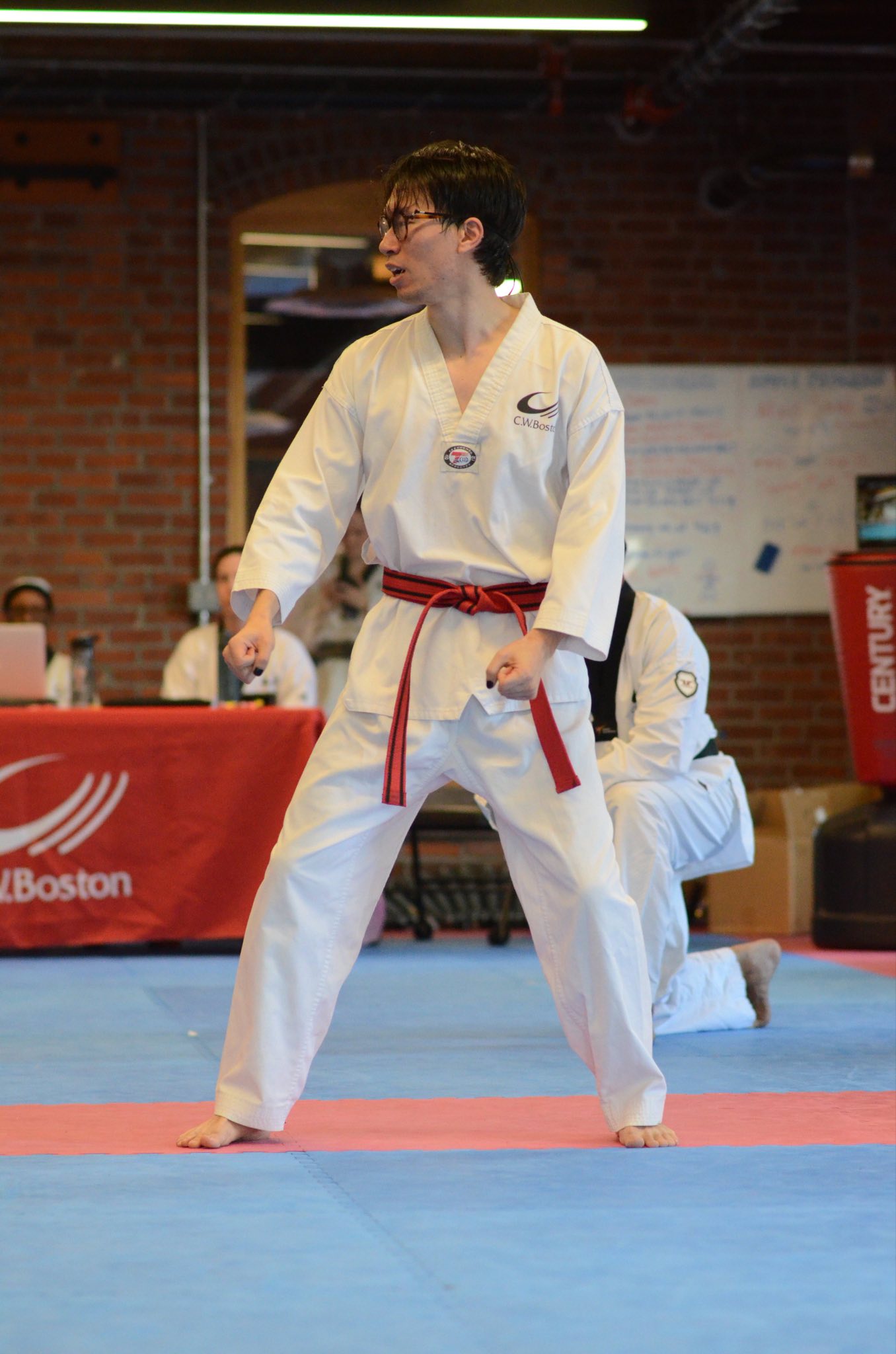
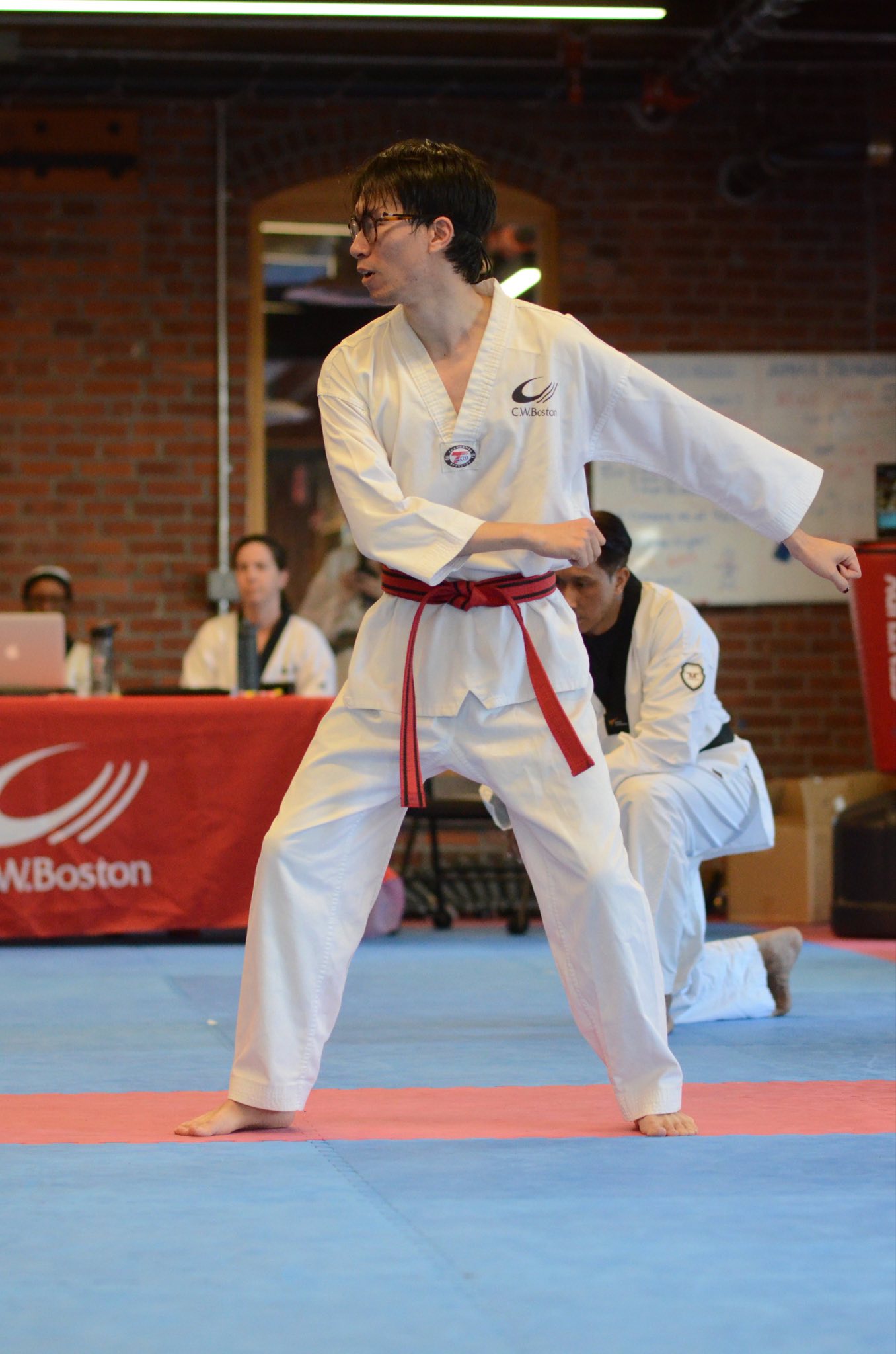
<?xml version="1.0" encoding="utf-8"?><feed xmlns="http://www.w3.org/2005/Atom" ><generator uri="https://jekyllrb.com/" version="3.10.0">Jekyll</generator><link href="https://jonathanzong.com/feed.xml" rel="self" type="application/atom+xml" /><link href="https://jonathanzong.com/" rel="alternate" type="text/html" /><updated>2026-07-27T22:24:41+00:00</updated><id>https://jonathanzong.com/feed.xml</id><title type="html">Jonathan Zong</title><entry><title type="html">Reflecting on 1st Dan in Taekwondo</title><link href="https://jonathanzong.com/blog/2025/03/31/reflecting-on-1st-dan" rel="alternate" type="text/html" title="Reflecting on 1st Dan in Taekwondo" /><published>2025-03-31T00:00:00+00:00</published><updated>2025-03-31T00:00:00+00:00</updated><id>https://jonathanzong.com/blog/2025/03/31/reflecting-on-1st-dan</id><content type="html" xml:base="https://jonathanzong.com/blog/2025/03/31/reflecting-on-1st-dan"><![CDATA[<p><em>On March 22, 2025, I tested for my 1st dan black belt at CW Taekwondo Boston. As part of this process, I was asked to write an essay reflecting on my relationship to taekwondo. I’m sharing a version of it here, lightly edited to remove some names for privacy.</em></p>

<div class="col-xs-3">
  <img src="/images/blog/tkd/01.jpg" alt="1 of 4. I'm preparing to do my board break at the end of the test. I'm standing in a ready stance, chest toward the camera but looking toward the left where I will be kicking. My arms are hanging low to the ground, hands in fists." />
</div>
<div class="col-xs-3">
  <img src="/images/blog/tkd/02.jpg" alt="2 of 4. I swing my hands away from the direction I'm looking, preparing to jump." />
</div>
<div class="col-xs-3">
  <img src="/images/blog/tkd/03.jpg" alt="3 of 4. My back knee came up and I'm lifting off the ground to jump and spin away from the camera in the air. My arms are coming up to help with the momentum of the spin." />
</div>
<div class="col-xs-3">
  <img src="/images/blog/tkd/04.jpg" alt="4 of 4. I'm in the air, having turned 360 degrees so my chest is facing the camera again. My front leg is extended toward the board on the left, and I'm preparing to pull my heel through the board." />
</div>

<p>Taekwondo has meant many things to me. Rather than try to summarize all of it at once, I’d like to reflect on my relationship to taekwondo through a few different perspectives.</p>

<h1 id="taekwondo-as-a-lesson-in-self-image">Taekwondo as a lesson in self-image</h1>

<p>When I started taekwondo, it was out of character for me — or so I thought. I never really thought of myself as a sporty person. As I started practicing taekwondo more consistently and discovering a lot of joy in it, it made me interrogate why I had this perception of myself. It wasn’t even necessarily factual — even though I’d not really “done sports” for most of my adult life, as a child I’d played baseball and even taken some karate classes, and had also enjoyed casually running with friends in college. I had always assumed that sports were frivolous or that I didn’t really have time for it, but seeing how essential it had become to my happiness made me re-evaluate a few things about the narrative that I viewed my own life through.</p>

<p>I recently learned about a concept in education called self-efficacy. Self-efficacy is a person’s belief in their own ability to achieve an outcome. Research has shown that higher self-efficacy is linked to task-specific success. In other words, believing that you can do something is an important component of actually being able to do it. This has rung true for me in my experience of taekwondo. I feel the most excited about taekwondo when I achieve a good balance of challenging myself and understanding that there’s room to improve, while still cultivating a feeling of competence and awareness of how far I’ve already come. Shifting my self-image to think of myself as a dedicated taekwondo practitioner, and take myself seriously on that level, has been an important part of the journey.</p>

<h1 id="taekwondo-as-a-reason-to-be-here-right-now">Taekwondo as a reason to be here right now</h1>

<p>Before I started taekwondo, I don’t think I felt a strong attachment to the Boston area. I had friends here, and I liked being here, but otherwise it was mostly the place where my job was. I didn’t feel like it mattered whether or not I stayed longer term. The pandemic made this feeling really acute because it maybe literally did not matter — everything was on the computer and I couldn’t spend meaningful time with anyone in person even if they were nearby anyway. The CW community really changed that for me. I met a lot of people who I hope will be lifelong friends. I met my partner here. I also made a lot of what one of my church leaders would call “high-quality acquaintanceships” — people who I am genuinely happy to see regularly because our life cadences intersect. And I genuinely think that having high-quality acquaintanceships is something we all need, and that the comfort we all find in that consistency of routine we share is a sign of a healthy community.</p>

<p>Now, the prospect of moving on to a new city takes on a very different emotional valence than it would have before. And I feel so fortunate to have found something that makes me feel that way. I know that nothing is permanent — even if I were staying in Boston long term, everyone else is on their own path and the people that make up this community will inevitably change. But it’s made me really value being here, now, in the present moment.</p>

<h1 id="taekwondo-as-a-community-of-practice">Taekwondo as a community of practice</h1>

<p>When I was a yellow belt, one of my instructors said something in her class that really stuck with me. Though taekwondo seems like an individual endeavor, we can’t do it alone. We need a community of people around us for us to succeed. We need mentorship from people who are further along than us, and we need to pass that on to the people who are coming along behind us. This has been really true to my experience. I don’t know if I could have gone through this process without my belt group buddies, without help from the instructors and senior color belts, and without being pushed to understand things well enough to explain them to lower belts.</p>

<p>In my academic work, we talk about the idea of a community of practice. A community of practice is a “group of people who share a concern or a passion for something they do and learn how to do it better as they interact regularly.” None of us can do it alone and we make each other better by doing it together.</p>

<h1 id="taekwondo-as-a-way-to-grow-as-a-teacher">Taekwondo as a way to grow as a teacher</h1>

<p>In my non-taekwondo life, one of my goals is to help train the next generation of civically-minded technologists and designers. I do this in my capacity as a teacher and as a research mentor. I try to think about my informal experiences with teaching in taekwondo as mutually-reinforcing with how I’m trying to grow as a teacher in the rest of my life. Taekwondo is a form of embodied knowledge, which is unique compared to other types of knowledge. If you’ve ever tried to learn a dance, or asked your Chinese mother how to roll dough, you know that embodied knowledge is hard to write down or even convey in words. It’s always passed body-to-body. Taekwondo is always instantiated in someone’s body, and everyone’s body is different. You can show someone by doing, but what you’re really trying to convey is a feeling that might not even be the same feeling in their body. Trying to help others with taekwondo technique has pushed me to think about my communication style and my capacity to take on a beginner mindset.</p>

<h1 id="taekwondo-as-inheriting-a-dream">Taekwondo as inheriting a dream</h1>

<p>Because taekwondo is embodied knowledge, and this knowledge is reproduced at the level of a community of practice in a specific place and time, it can be different wherever you go. I’ve discovered over time that I’m not just learning taekwondo — I’m learning a perspective on taekwondo that belongs to the CW Taekwondo community. From conversations with instructors, I’ve realized that the club has its own unique perspective such that when we perform our poomsae at tournaments, we want to be recognizable as CW students (for example, through our use of rhythm and tempo).</p>

<p>When our Grandmaster visited us in Dec 2023, he told us from his seat at the head table, “my ideas and dreams live on in all of you.” This process has helped me better understand what he means. No matter what form my relationship with taekwondo takes in the future, I hope I will be a good representative of CW’s ideas and dreams when I share my taekwondo with others.</p>

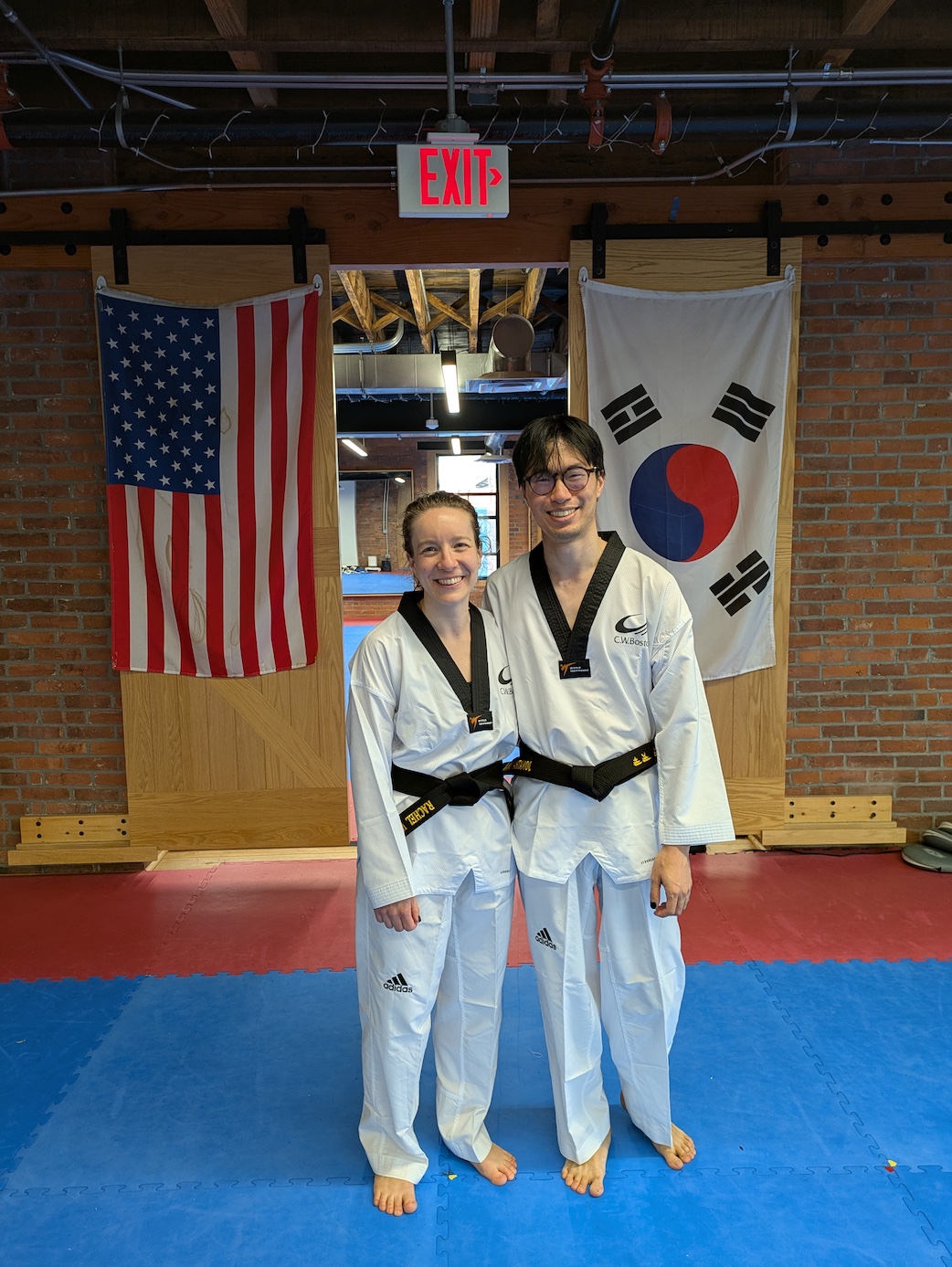
<p><img src="/images/blog/tkd/bb.jpg" alt="My partner and I pose with our new black belt uniforms in front of the US and Korean flags. The uniforms are white with a black trim around the neck lapel area and our belts have our names embroidered in yellow on them, with a single stripe at one of the ends signifying 1st dan." /></p>]]></content><author><name></name></author><summary type="html"><![CDATA[On March 22, 2025, I tested for my 1st dan black belt at CW Taekwondo Boston. As part of this process, I was asked to write an essay reflecting on my relationship to taekwondo. I’m sharing a version of it here, lightly edited to remove some names for privacy.]]></summary></entry><entry><title type="html">Data Refusal in Conversation with List Projects 31: Kite</title><link href="https://jonathanzong.com/blog/2025/03/31/refusal-kite" rel="alternate" type="text/html" title="Data Refusal in Conversation with List Projects 31: Kite" /><published>2025-03-31T00:00:00+00:00</published><updated>2025-03-31T00:00:00+00:00</updated><id>https://jonathanzong.com/blog/2025/03/31/refusal-kite</id><content type="html" xml:base="https://jonathanzong.com/blog/2025/03/31/refusal-kite"><![CDATA[<p><em>On March 5, 2025, I gave a <a href="https://listart.mit.edu/calendar/graduate-student-talk-jonathan-zong">talk at the MIT List Visual Arts Center</a> as part of a public engagement talk series that pairs researchers with ongoing exhibitions at the List. Below is a video and transcript of that talk.</em></p>

<style>
.video-container {
  position: relative;
  width: 100%;
  max-width: 100% !important;
  padding-bottom: 56.25%;
  margin: 0 auto 1em auto !important;
}
.video {
  position: absolute;
  top: 0;
  left: 0;
  width: 100%;
  height: 100%;
  border: 0;
}
img {
	margin-top: 2em;
}
</style>

<div class="video-container">
	<iframe class="video" src="https://www.youtube-nocookie.com/embed/GZJGUE9JJK0?si=T7Uy8UbAxWg4dVzp" title="YouTube video player" frameborder="0" allow="accelerometer; autoplay; clipboard-write; encrypted-media; gyroscope; picture-in-picture; web-share" referrerpolicy="strict-origin-when-cross-origin" allowfullscreen=""></iframe>
</div>

<h2 id="introduction-by-cassidy-westjohn">Introduction by Cassidy Westjohn</h2>

<p>Hi, everyone. Thanks so much for coming out tonight. My name is Cassidy Westjohn. I’m the public programs coordinator here. Welcome to the List Visual Arts Center. And this is a Graduate Student Talk with Jonathan Zong.</p>

<p>This is a series where we invite graduate students and postdoc researchers to expand on our exhibitions using their expertise in a similar subject-matter as a way to see how art and research are overlapping on MIT’s campus.</p>

<p>Tonight, we’ll be hearing from Jonathan Zong, a Postdoctoral Associate at MIT CSAIL, and fellow at Harvard’s Berkman Klein Center for Internet and Society, and who will be an assistant professor in Information Science at University of Colorado Boulder in 2025.</p>

<p>In his research, Jonathan partners with blind collaborators and study participants to co-design interfaces for non-visual data exploration. He also developed software and conceptual frameworks for managing the ethics of consent and large scale social media data collection.</p>

<p>Jonathan’s work has been recognized by the MIT Morningside Academy for Design Fellowship, the Paul &amp; Daisy Soros Fellowship for New Americans, and Forbes 30 under 30 scientists.</p>

<p>In this talk, Jonathan will explore this central question. How do people say no when they’re not given permission to say no? Feminists and Indigenous scholars and activists have developed the concept of refusal as something that people with the least power in society can take up to challenge authority and open up new possibilities.</p>

<p>Jonathan will discuss his research on data refusal as design, how people work to reshape systems of large scale data collection. Zong will draw connections between this work and Kite’s artistic and scholarly engagement with Lakȟóta ontologies and Indigenous AI.</p>

<p>At the end, we’ll have a Q&amp;A, where you’ll have a chance to ask any questions you may have. And that is it. So thank you so much for being here and showing interest in our programming. And I’ll hand it off now to Jonathan.</p>

<h2 id="jonathan-zongs-talk">Jonathan Zong’s Talk</h2>

<p>Thank you so much, Cassidy, for that introduction. And thank you to you and the List for having me here tonight.</p>

<p>So the goal of my talk today is to introduce some of my work on the idea of data refusal and put it in conversation with the work that you see here by the artist <a href="https://www.kitekitekitekite.com/">Kite</a>, who is a Lakȟóta artist and scholar, multi-talented visual artist, performer, composer, also a professor at Bard College. And it’s my hope that hearing about some of my work will help you see some of these works in a new way and have interesting conversations around them.</p>

<p>So my work engages with the idea of data refusal, and I’ll break this talk apart into maybe like three parts.</p>

<p>First, I’ll introduce the idea of refusal and talk about where that idea comes from. Then I’ll go deeper into my work on the idea of refusal as an act of design and how it contributes to design and computer science and the creation of technology. And then lastly, third, I will draw connections between my work and the work by Kite that you see around you. And then we’ll open the conversation for Q&amp;A from there.</p>

<h3 id="what-is-refusal">What is Refusal?</h3>

<p>So first, what is refusal? As Cassidy suggested, I think about refusal as this idea of saying no without being given permission to say no. And it’s an intentionally broad concept. It’s a way of describing a category of thing that people do.</p>

<p>And the reason we have a concept that’s intentionally this broad is because it describes actions that people take in a lot of different situations, in a lot of different areas of society.</p>

<p>And we think about refusal in the context of data. When we talk about data, we’re talking about something that’s very ubiquitous. It’s information about people that’s automatically collected and then used in a lot of different areas that are inputs into decisions that have a lot of important social consequences.</p>

<p>So whether that’s data about you that goes into your credit score or some pretrial risk assessment algorithm or any other number of systems. Because data touches so many areas of life, the situations that people find themselves in when they are practicing refusal against data are very varied.</p>

<p>So we’re thinking about things like, there was a family who tried to hide their pregnancy from e-commerce ad targeting algorithms. And they had to do things like use cash and be careful about what they typed into Google and things like that.</p>

<p>There’s examples of advocacy organizations, like organizing people into class action lawsuits against governments and companies for using racially-biased facial recognition algorithms in services or policing.</p>

<p>And there’s even direct forms of refusal, like protesters in Hong Kong taking saws and chopping down lampposts because they might have surveillance cameras in them.</p>

<p>So even though these various actions all look different from each other, some are things that individuals do, some are organized legal actions, some are maybe illegal actions. The idea of refusal helps us see these different concepts as part of the same phenomenon or same movement in society.</p>

<h3 id="origins-of-refusal-as-a-concept">Origins of Refusal as a Concept</h3>

<p>So refusal is an idea that comes from scholarship and thinking from feminist and Indigenous scholars. And I’ll talk a bit about what it means to name those as the conversations that we’re starting from.</p>

<p>So if we think about consent, maybe as an example of a conversation that feminist scholars have found very important in recent years, the idea that for consent to be freely given, being able to say no without coercion or any outside influence is really important.</p>

<p>And I think that feminist perspective of thinking about power when it comes to decisions and consent informs ideas of refusal, where sometimes companies who are asking for our data, give us an opt-out button, or either agree to the terms and conditions or just like, don’t use this thing. And those aren’t equally weighted options.</p>

<p>So a feminist analysis of power helps us see maybe all the choices on the table are bad. And refusal turns into a way of not just saying yes or no to an option that’s presented to you, but even questioning why aren’t other alternatives on the table and questioning the legitimacy and authority of people who are offering us these constrained choices.</p>

<p>And a lot of conversations around refusal have happened in the context of ideas around biological citizenship, which is really important to Indigenous scholars who are thinking about what makes someone a citizen of a sovereign nation and what happens when external governments and forces try to impose a way of identifying you based on things like your genetic ancestry, that might not align with the way that you see yourself or the social reality of the communities that you live in.</p>

<h3 id="an-example-of-refusal-in-practice">An Example of Refusal in Practice</h3>

<p>So I’ll give an example of one maybe inspiring instance of refusal that I think exemplifies a way that refusal can be a thing that not just says no to a thing in the present, but also suggests alternate future possibilities.</p>

<p>So there’s a movement called Indigenous Data Sovereignty. And one of the organizations that’s been leading this movement is called the First Nations Information Governance Center. And the story of that center is that there were First Nations groups in Canada that had been systematically left out of health surveys that were conducted by the Canadian government.</p>

<p>And these were sovereign nations. And the Canadian government wasn’t necessarily thinking of them in the way that they were thinking of themselves. But they also felt the effects of being left out. No data about them meant that they maybe weren’t getting as good access to resources that were being allocated on the basis of this data.</p>

<p>So they ended up doing bottom-up community-led development process of an alternate regional health survey that was made by and for First Nations people. And then taking that to the Canadian government and saying like, this is the data that we want to be understood by.</p>

<p>And so refusal in this sense, was saying no to one kind of existing way of working, but also proposing an alternative.</p>

<h3 id="data-refusal-as-design">Data Refusal as Design</h3>

<p>And this ties into– the reason I think this serves as an inspiration for my work is that much of what I’ve been thinking about is the idea of data refusal as an act of design.</p>

<p>So I work in a computer science department, where I’m thinking about designing technology. Making decisions about how technology should work, what kinds of inputs should go into technology, and where it should be deployed in the world.</p>

<p>And I think conventionally, computer scientists think of technology non-use as like a form of deprivation or a lack of access. So the assumption maybe is that if people are not using the thing that we built, we just need to make our thing better, and then people will then use it. Once it’s more usable or user friendly.</p>

<p>And that starts from an assumption that the thing that we decided to build is like a thing that people want in the first place.</p>

<p>And so I think something that’s interesting about refusal from the context of this conversation about technology design is that refusal is a way for people who have historically not been part of these conversations—about what technology should be designed, how it should be designed, how it should be used in the first place—to have a say.</p>

<p>And we can look at acts of refusal, like people avoiding the use of certain technologies or trying to get them banned through the law as responses to one version of a set of relationships between technology and society that’s being advanced.</p>

<p>And maybe behind that refusal, there’s the seed of an alternative. Refusal is always implicitly about we would rather not have this, we would rather have something else.</p>

<p>And even if we don’t know what that something else is, I think considering refusal as a kind of legitimate way of engaging with technology helps us see those instances where our current technologies are maybe insufficient or helps us see the unequal power relations that go into the development of technology.</p>

<h3 id="connections-with-kites-work">Connections with Kite’s Work</h3>

<p>And because Kite’s work weaves together her scholarly and artistic background so well, I think there’s a lot of ways that I see my work and hers as potentially being in conversation.</p>

<p>I first learned about Kite’s work on the scholarly side of her work, where she has done a lot of writing around how Lakȟóta ways of thinking and ontologies and perspectives around how people relate to materials and other non-human entities, how all of that can inform practices of design.</p>

<p>So she has this essay called How to Design Anything Ethically or something like that. And it’s taking the perspective of what can we learn from– she as a Lakȟóta citizen, is really engaging with her community’s cultural practices.</p>

<p>And she walks through this example of the process and the thought that goes into designing a Lakȟóta sweat lodge. And breaks down that process into a framework that might apply to the design of other things.</p>

<p>So she uses that as a template for thinking about what would be a starting point for trying to design AI more ethically.</p>

<p>And I guess, a lot of her work deals with this idea of process and protocol. And she describes protocol as decisions and actions that define relationships between humans and non-humans.</p>

<p>She talks about the stars and the stones, the local and the global. And she’s thinking about the way that we decide how to do things affects the outcomes that are created.</p>

<p>And I think even though she might not explicitly use the word design all the time, I think this is very resonant with the way that I’m thinking about refusal as design, refusal as part of a process of society collectively coming to terms with decisions about what technology should be.</p>

<h3 id="protocol-and-materiality-in-kites-exhibition">Protocol and Materiality in Kite’s Exhibition</h3>

<p>And in the gallery here, I can talk a bit about the centerpiece of this show, which is a piece called Dreamlike Star.</p>

<p>And it’s a multi-part– there’s this film aspect, there’s a flat sculpture on the ground made of stone. And there’s this graphical component that’s on the wall.</p>

<p>And the piece is about– Kite worked with a Lakȟóta designer or visual artist to create what they call a shape kit. So a set of icons, shapes that serve as a visual vocabulary.</p>

<p>And she used that to translate three months of her dreams into a visual score that then informs a performance that takes place between a performer and a set of instructions that are on the wall.</p>

<p>So you can see how the idea of protocol is taking shape in this piece where a performer is kind of following a score, which is a set of instructions, maybe behaving in a machine-like way.</p>

<p>And she, in her performance, has sensors and she has this braid of hair that she created that’s also a musical instrument with machine learning models that she trained herself, that map her movements and the movements of the braid into musical output.</p>

<p>And I think the engagement with materials like her own hair or the stones that we see here, I see as important to her engagement with her Lakȟóta background. She describes computers as melted stones that are mined from the Earth.</p>

<p>And I think this attention to material echoes some other conversations that are happening too in conversations about the sustainability of AI. There’s a big lithium mine in Nevada that powers a lot of AI systems that’s built on the ancestral land of Indigenous peoples. And the way that we think about AI as something that’s abstract and maybe disembodied, but it’s really something that is being created from resources that are from the Earth and is situated in a place and is altering the relationship that we have with these materials.</p>

<h3 id="conclusion">Conclusion</h3>

<p>When I think about her work, I see this kind of concern with the context and the place in which things are happening. And I think about the idea that refusals are always situated in a context and responding to things that are maybe happening in specific communities and specific cultures and as a result, no two responses that people will have even to the same type of data system will look the same.</p>

<p>But I think attending to that specificity is actually an important way that we push back against the way that we are often encouraged to think about AI as removed from our surrounding environments and ecologies and communities.</p>

<p>So I think I’ll wrap it up there, and open it up for questions. But thank you for coming to this talk, and I hope you enjoyed.</p>]]></content><author><name></name></author><summary type="html"><![CDATA[On March 5, 2025, I gave a talk at the MIT List Visual Arts Center as part of a public engagement talk series that pairs researchers with ongoing exhibitions at the List. Below is a video and transcript of that talk.]]></summary></entry><entry><title type="html">Celebrating Lantern Rite, My Favorite Fictional Holiday</title><link href="https://jonathanzong.com/blog/2025/01/29/celebrating-lantern-rite" rel="alternate" type="text/html" title="Celebrating Lantern Rite, My Favorite Fictional Holiday" /><published>2025-01-29T00:00:00+00:00</published><updated>2025-01-29T00:00:00+00:00</updated><id>https://jonathanzong.com/blog/2025/01/29/celebrating-lantern-rite</id><content type="html" xml:base="https://jonathanzong.com/blog/2025/01/29/celebrating-lantern-rite"><![CDATA[<p><img src="/images/blog/lantern-rite/20250125171543_png_.png" alt="Screenshot of outdoor decorations in Genshin Impact with hanging lanterns, colorful umbrellas, and banners. My character Ganyu is posing for the photo." /></p>

<p>Every year, I look forward to celebrating the Lantern Rite Festival, a fictional holiday in the world of Genshin Impact based on Lunar New Year. Despite the fact that I don’t play this game regularly anymore, Lantern Rite remains one of my favorite holiday traditions to celebrate. When I logged into the game, it had been nearly a year since the last time I walked around Liyue Harbor, an in-game city inspired by China (and likely modeled after parts of Hunan Province). Yet, it felt just like visiting somewhere I used to live; recognizing streets I used to frequent, and taking comfort in the idea that life has gone on without me for everyone there.</p>

<p>Why does Lantern Rite mean so much to me? I started playing Genshin Impact around its launch in September 2020. Back then, a lack of information meant that many had hoped quarantine would only last a few months, and I was coming to terms with how wrong that expectation was, and how little I knew about the future. I also wasn’t going anywhere, and spent a lot of time walking around the landscape of Teyvat, Genshin Impact’s fictional world.</p>

<p>That’s why, when the first iteration of Lantern Rite Festival happened in February 2021, a lot of feelings surfaced for me. Growing up, I had relied on my parents to know how to celebrate Lunar New Year. Later, I found new ways to celebrate with friends. But in 2021, I was away from my family and friends for an indefinite amount of time. I didn’t feel like I was in the right headspace to celebrate anything, and felt unmoored from tradition.</p>

<p>Playing through that year’s Festival event, I recognized my feelings in the characters and story. We meet Xiao, who is a protector spirit of sorts who watches over Liyue Harbor. A hero from days past, he feels both connected to and apart from the people he serves. As we explore the city, we learn that for the people of Liyue, the meaning of the “Xiao Lanterns” they light is to serve as a beacon, guiding bygone heroes back to their homeland. Though Xiao feels like his apartness from the people he loves is insurmountable, we persistently try to convince him to celebrate with us. Eventually, we bring the celebration to him, sharing a quiet meal on the outskirts of town.</p>

<p><img src="/images/blog/lantern-rite/dialogue.png" alt="Dialogue from Lantern Rite 2021. Ah... &quot;May the flames of wisdom spread to all, and never be extinguished.&quot; This is the meaning of the lanterns. We believe they act as beacons in the night, guiding bygone heroes back to their homeland." /></p>

<p>In subsequent years, with each Lantern Rite Festival comes new characters and new stories of people finding their way back home. Last year, I returned to Liyue to learn that the theme of the year’s Lantern Rite was kites. In the story, we meet Gaming—a young man who has a strained relationship with his father. Gaming dreams of becoming a Wushou dancer, but his father wants him to run the family tea business instead, causing Gaming to leave home. As we work to help the father and son reconcile, the father comes to see that raising a child is not unlike flying a kite—hold the string too tight, and it can no longer soar. The story ends with a touching reconciliation, as the father accepts his son’s dreams.</p>

<p>At its heart, the story of Lantern Rite—and the wider story of Genshin Impact—is a story about reconciliation. In Genshin Impact, you play as the Traveler. Alongside their sibling, they journeyed across worlds until one day they were stranded in Teyvat. Separated from their sibling, they live in exile and dream of the day of their reunion. But as they search across the land for their lost family, they forge new relationships, find new people and places amongst which they feel at home, and make new treasured memories.</p>

<p>In the Traveler’s story, I see something essential about the Asian American experience. Sociologist Russell Jeung <a href="https://www.inheritancemag.com/stories/an-exiles-dream-for-justice">writes</a> that alongside African American theologies of liberation and Latinx theologies of the borderlands, Asian Americans have a theology of exile due to our status as forever foreigners wherever we are. Asian American theology acknowledges the difficulties of existing within inhospitable conditions and longing for home and belonging. It also embraces the possibility of becoming rooted in community, investing in relationships, and cultivating mutual commitments of care.</p>

<p>We yearn to find our way back home. But along the way, home might just find us where we already are.</p>]]></content><author><name></name></author><summary type="html"><![CDATA[]]></summary></entry><entry><title type="html">Improving our Digital Environments with Citizen Science: J. Nathan Matias at the MIT Data + Feminism Lab</title><link href="https://jonathanzong.com/blog/2024/10/25/improving-our-digital-environments" rel="alternate" type="text/html" title="Improving our Digital Environments with Citizen Science: J. Nathan Matias at the MIT Data + Feminism Lab" /><published>2024-10-25T00:00:00+00:00</published><updated>2024-10-25T00:00:00+00:00</updated><id>https://jonathanzong.com/blog/2024/10/25/improving-our-digital-environments</id><content type="html" xml:base="https://jonathanzong.com/blog/2024/10/25/improving-our-digital-environments"><![CDATA[]]></content><author><name></name></author><summary type="html"><![CDATA[]]></summary></entry><entry><title type="html">Building a Community-Focused Laboratory, with Max Liboiron</title><link href="https://jonathanzong.com/blog/2022/02/26/building-a-community-lab" rel="alternate" type="text/html" title="Building a Community-Focused Laboratory, with Max Liboiron" /><published>2022-02-26T00:00:00+00:00</published><updated>2022-02-26T00:00:00+00:00</updated><id>https://jonathanzong.com/blog/2022/02/26/building-a-community-lab</id><content type="html" xml:base="https://jonathanzong.com/blog/2022/02/26/building-a-community-lab"><![CDATA[]]></content><author><name></name></author><summary type="html"><![CDATA[]]></summary></entry><entry><title type="html">Designing and Evaluating Research Ethics Systems</title><link href="https://jonathanzong.com/blog/2022/02/15/designing-and-evaluating-research-ethics-systems" rel="alternate" type="text/html" title="Designing and Evaluating Research Ethics Systems" /><published>2022-02-15T00:00:00+00:00</published><updated>2022-02-15T00:00:00+00:00</updated><id>https://jonathanzong.com/blog/2022/02/15/designing-and-evaluating-research-ethics-systems</id><content type="html" xml:base="https://jonathanzong.com/blog/2022/02/15/designing-and-evaluating-research-ethics-systems"><![CDATA[]]></content><author><name></name></author><summary type="html"><![CDATA[]]></summary></entry><entry><title type="html">Reclaiming Data, Reclaiming Narratives: Jonathan Dewar, Sofia Locklear, and Jason Lewis on Indigenous Data Sovereignty</title><link href="https://jonathanzong.com/blog/2022/01/27/reclaiming-data-reclaiming-narratives" rel="alternate" type="text/html" title="Reclaiming Data, Reclaiming Narratives: Jonathan Dewar, Sofia Locklear, and Jason Lewis on Indigenous Data Sovereignty" /><published>2022-01-27T00:00:00+00:00</published><updated>2022-01-27T00:00:00+00:00</updated><id>https://jonathanzong.com/blog/2022/01/27/reclaiming-data-reclaiming-narratives</id><content type="html" xml:base="https://jonathanzong.com/blog/2022/01/27/reclaiming-data-reclaiming-narratives"><![CDATA[]]></content><author><name></name></author><summary type="html"><![CDATA[]]></summary></entry><entry><title type="html">Pointing, Mutual Intelligibility, and the Seeing Subject in HCI</title><link href="https://jonathanzong.com/blog/2021/04/29/seeing-subject" rel="alternate" type="text/html" title="Pointing, Mutual Intelligibility, and the Seeing Subject in HCI" /><published>2021-04-29T00:00:00+00:00</published><updated>2021-04-29T00:00:00+00:00</updated><id>https://jonathanzong.com/blog/2021/04/29/seeing-subject</id><content type="html" xml:base="https://jonathanzong.com/blog/2021/04/29/seeing-subject"><![CDATA[]]></content><author><name></name></author><summary type="html"><![CDATA[]]></summary></entry><entry><title type="html">Building Collective Power to Refuse Harmful Data Systems</title><link href="https://jonathanzong.com/blog/2020/08/12/collective-refusal" rel="alternate" type="text/html" title="Building Collective Power to Refuse Harmful Data Systems" /><published>2020-08-12T00:00:00+00:00</published><updated>2020-08-12T00:00:00+00:00</updated><id>https://jonathanzong.com/blog/2020/08/12/collective-refusal</id><content type="html" xml:base="https://jonathanzong.com/blog/2020/08/12/collective-refusal"><![CDATA[]]></content><author><name></name></author><summary type="html"><![CDATA[]]></summary></entry><entry><title type="html">Restorative Justice Approaches to Addressing Online Harm: Niloufar Salehi at CAT Lab</title><link href="https://jonathanzong.com/blog/2020/07/29/restorative-justice-approaches-to-addressing-online-harm" rel="alternate" type="text/html" title="Restorative Justice Approaches to Addressing Online Harm: Niloufar Salehi at CAT Lab" /><published>2020-07-29T00:00:00+00:00</published><updated>2020-07-29T00:00:00+00:00</updated><id>https://jonathanzong.com/blog/2020/07/29/restorative-justice-approaches-to-addressing-online-harm</id><content type="html" xml:base="https://jonathanzong.com/blog/2020/07/29/restorative-justice-approaches-to-addressing-online-harm"><![CDATA[]]></content><author><name></name></author><summary type="html"><![CDATA[]]></summary></entry></feed>